Research Scale
High-Throughput Screening

Clinical Manufacturing
Application | Traditional Approach | Key Issues | Avg Delay and Cost | Portal's Approach | Key Advantages |
|---|---|---|---|---|---|
DEL Screening | Cell-free biochemical or lysate screens | DNA tags cause impermeability; miss cellular context | 6–12 months; $500K–$1M MedChem before cell testing | Delivers DEL compounds into cytosol, enabling live-cell screening despite DNA barcode impermeability | Early biological de-risking; bypass MedChem for non-viable hits; immediate cellular testing |
Target Engagement | Cell lysates or permeabilized cells (CETSA, BRET, FRET) | Destroys native environment; impermeable tracers require lysis | 2–4 weeks per compound; limited to permeable probes | Delivers NanoBRET/CETSA reagents into intact cells, enabling real-time drug-target measurement | Real-time kinetics in intact cells; preserves target conformation and post-translational modifications |
PROTAC Discovery | Lysate-based assays; engineered lines; endpoint measurements | Miss temporal dynamics; cannot use primary cells; destroys degradation machinery | 4–8 weeks validation; $200K–$500K per candidate | Delivers LgBiT for intracellular HiBiT complementation, enabling real-time degradation monitoring | Live-cell kinetic profiling; test in primary cells; real-time pharmacology |
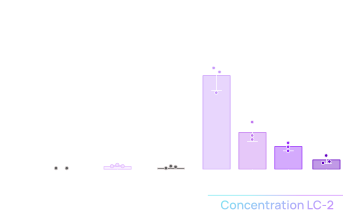
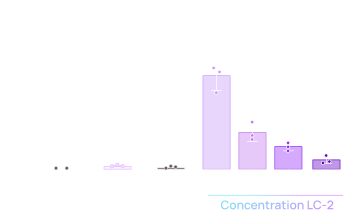
Macrocyclic or Linear Peptides | Limited to permeable peptides; low-efficiency endocytosis | 80% of chemical space inaccessible; modifications compromise activity | 12–18 months permeability optimization; frequent failures | Achieves ~80% delivery in HEK293 with linear dose-response, decoupling permeability from binding optimization | Access full peptide chemical space; optimize binding without permeability constraints |
Hit-to-Lead | Biochemical screen → MedChem → cell testing | MedChem investment before validation | ~1 year; $1M+ before cell validation | Enables direct-to-biology screening—test hits immediately in live cells before MedChem investment | Verify activity before MedChem; save time and money on non-viable scaffolds |
Phenotypic Screening | Engineered lines; electroporation causes dysfunction | Primary cells difficult to transfect; electroporation alters phenotypes | 3–6 months; limited to model lines | Delivers compounds into primary cells at HTS scale, preserving function in iPSCs, T cells, disease-relevant types | Disease-relevant primary cell screens; preserved phenotypes; efficient multiplex delivery; HTS compatible |