

HEK293 Cells

Deliver more. Stress less.

HEK293 cells are a workhorse for drug discovery, expression biology, and assay development. They're also a common starting point for validating cargo classes that can't cross the membrane on their own: non-permeable PROTACs, labeled macrocyclic peptides, and intact biologics. For these molecules, the bottleneck isn't the biology. It's the membrane. Teams spend months optimizing permeability, before they confirm whether the molecule even engages its target inside a live cell.

Portal flips that order. Deliver the impermeable molecule directly into HEK293 cytosol, and only invest in permeability work once the molecule proves worth it.
Start delivering now. Experimentally proven delivery workflows for live-cell screening in HEKs.

Workflow

Example Cell Type

Cargo

What this Unlocks

Macrocycle delivery

HEK293

FITC-labeled macrocyclic peptides

Live-cell macrocycle screening

Impermeable degrader / molecular glue delivery

HEK293

PROTACs, molecular glues, degrader-conjugate payloads

On-target functional readout (target depletion, downstream signaling) without designing the molecule for cell permeability, de-risk the target early

mRNA expression

HEK293

GFP mRNA

Transient overexpression for assay development & reagent production

Antibody delivery

HEK293

Fluorescent Antibody

Intracellular target staining & functional Ab screening

Triple-cargo multiplex

HEK293

3 kDa dextran + Antibody + oligo

One-shot delivery of tracer + antibody + nucleic acid to the same cell

Highlighted Data and Applications

Delivering Membrane-Impermeable Macrocyclic Peptides into HEK293


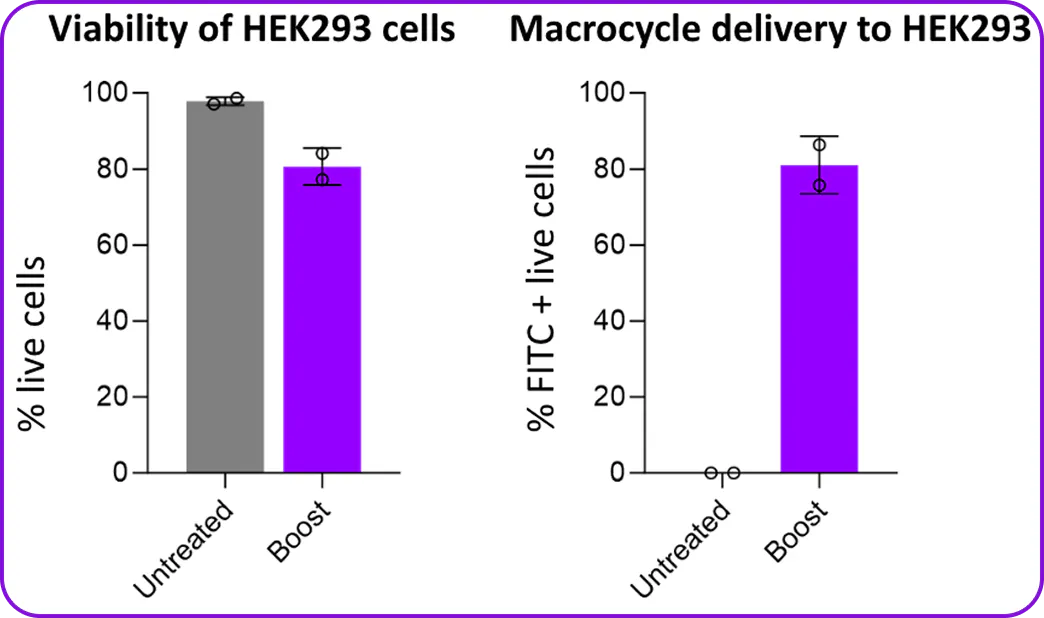
FITC-labeled macrocycles are often cell-impermeable, making intracellular delivery a persistent challenge. Portal-treated HEK293 cells reached 50%+ FITC+ live cells with viability preserved, while untreated controls showed no detectable FITC signal. Fluorescence microscopy confirmed uniform intracellular distribution across the population.

What this unlocks: live-cell screening of macrocycle libraries against intracellular targets, without re-engineering the chemistry for permeability.

Driving Transient GFP mRNA Expression in HEK293 Without Lipofection or Electroporation


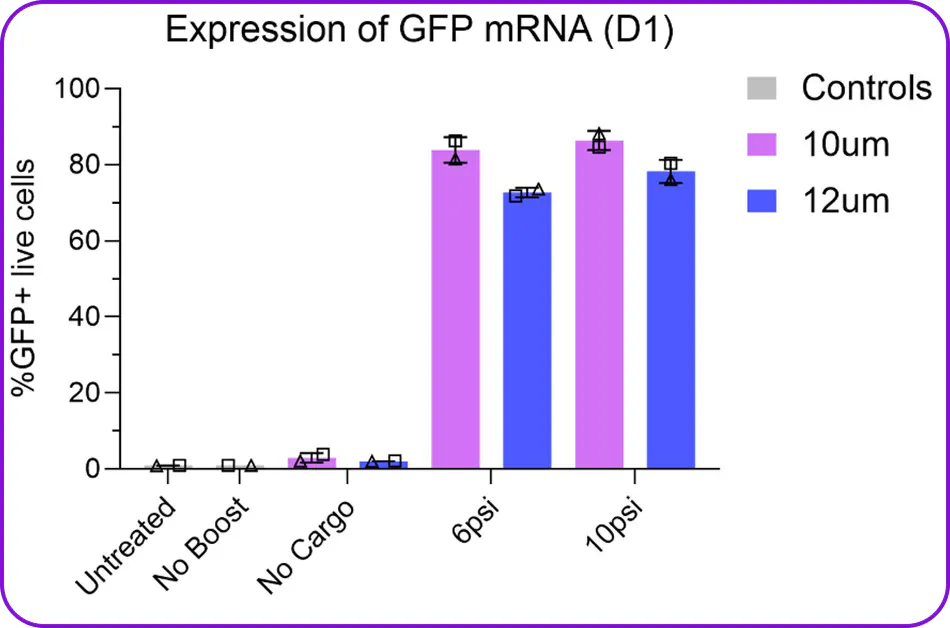
GFP mRNA (100 µg/mL) was delivered into HEK's in a single step via Portal and read out 24 h later, reaching 85%+ GFP+ live cells with viability preserved. Untreated and no-cargo controls showed essentially no GFP signal.

What this unlocks: mRNA-driven transient overexpression for fluorescent tags, reporter constructs, or secreted protein production, without lipid nanoparticles, electroporation, or viral vectors

Delivering Intact Antibodies into the HEK293 Cytosol

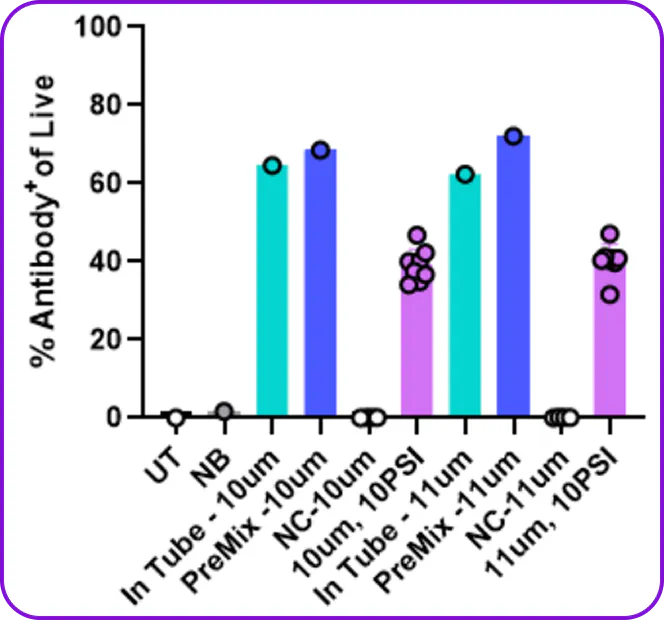
Fluorescently labeled IgG antibody (~150 kDa) was delivered into HEK293 cells with the same Portal workflow used for small molecules, reaching 60%+ antibody+ live cells by flow cytometry. Untreated and no-cargo controls showed no detectable signal.

What this unlocks: intracellular target staining in live cells, functional screening of neutralizers and degrader-conjugate antibodies, and antibody-based perturbations on the same cell line you already use.

Co-Delivering an Antibody, a Dextran, and an Oligonucleotide in a Single Step

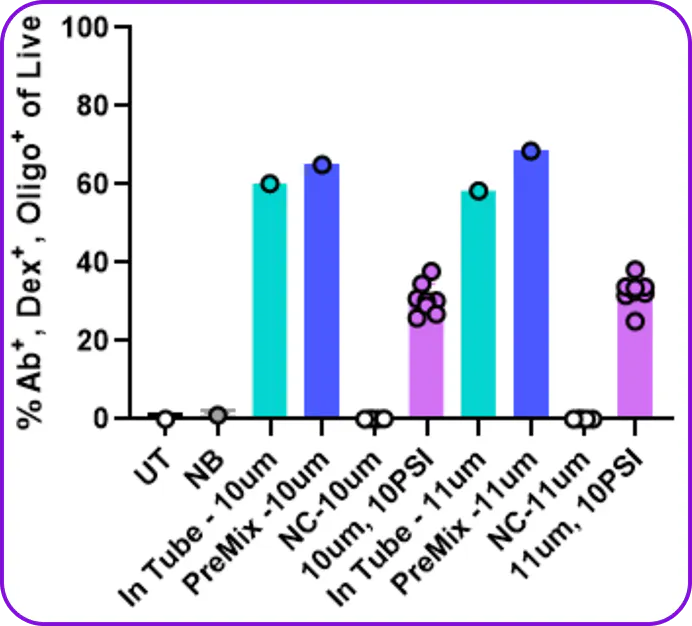
A 3 kDa dextran, a fluorescent IgG Ab, and a labeled oligonucleotide were combined and delivered to HEK293 cells in a single Portal step. All three cargo classes reached 60%+ delivery, with 55%+ of live cells triple-positive. Untreated and no-cargo controls were essentially negative across all channels.

What this unlocks: true multiplex intracellular delivery without serial transfections, re-optimization between cargo classes, or separate workflows for each modality.