

Unlocking Live-Cell Protein Detection Without Genetic Tags

The Challenge of Measuring Proteins in Live Cells

Understanding disease pathways and drug-target interactions often hinges on measuring specific proteins inside cells. Traditionally, scientists tag the protein of interest – for example with a fluorescent reporter or epitope label – which usually requires genetically modifying cells to express a tagged version of the protein. While this works in engineered cell lines, many biologically critical cell types (especially primary cells from patients or blood) are notoriously difficult to modify. And even when it does work the tag can alter the biology of the protein


Electroporation and viral vectors used to introduce tags or genes can severely stress or even fail in these cells: electroporation can cause substantial toxicity and gene dysregulation, and many viruses cannot infect quiescent primary cells1. This leaves researchers in a bind: How do we quantify a protein in live, hard-to-engineer cells without weeks of making custom cell lines or risking cell health?

A Mechanical Solution: Portal’s Mechanoporation Approach

Enter mechanoporation – a physical method to deliver probes into cells by briefly squeezing them through small pores. The concept is simple: force cells through a small constriction to mechanically disrupt the membrane for a brief time, so that large molecules ranging from nanotubes to full-size proteins  diffuse directly into the cytosol in dozens of cell types (including hard-to-transfect primary cells)3, 4. Crucially, this technique doesn’t rely on any specific cell-surface markers or custom vectors – it’s a universal, vector-free delivery platform driven by physics rather than biology1. 

Directly Measuring Intracellular Proteins without Tags

How does mechanoporation help measure untagged proteins? By allowing the directintroduction of targeted probes (like antibodies) with conjugated detection moieties (like fluorophores) into living cells. Instead of engineering the cell to express a tagged protein, we deliver a tag to the protein inside the cell. Portal’s mechanoporation technology can deliver essentially any membrane-impermeable reagents into the cell cytosol – including antibodies that bind your protein of interest3. 
Mechanoporation has shown effective cytosolic delivery of whole antibodies (~150 kDa) into cells alongside other large molecules with high efficiency1. Notably, multiple cargoes can be delivered at once. This multiplexed delivery means researchers could introduce several labeled antibodies in one step – for instance, to label and visualize multiple distinct intracellular proteins in a live cell. 

Benefits of Going Tag-Free in Primary Cells

What does this new capability mean for scientists? In short, it can be transformative for both research and translational applications. Some key advantages include:

  • Use the Right Cells, Not Just Convenient Cells: With mechanoporation, you can study primary patient-derived cells or difficult immune cells directly, rather than substituting an immortalized cell line. This provides data in the most disease-relevant cellular context, which is often critical for drug discovery. Primary cells that previously were “off-limits” for certain assays (due to transfection or tagging hurdles) can now be analyzed with intracellular readouts3. 
  • No Genetic Engineering Needed: There’s no need to create a GFP-tagged version of your protein or to virally overexpress a reporter. The mechanoporation approach is label-agnostic – the same platform can introduce any functional antibody or protein probe into the cell. 
  • Measure Native Protein Levels and Dynamics: Because we are detecting the endogenous protein in a live cell, we get an accurate picture of its natural expression and localization.
  • Multiplexed and Flexible Assays: Delivering multiple antibodies or probes together means you can assay several intracellular proteins or post-translational modifications in a single cell simultaneously. Portal’s platform has demonstrated the ability to co-deliver diverse payloads in one shot1, which is ideal for complex assays (e.g., colocalization studies, multi-target phenotyping, or multi-component drug mechanisms).
  • Preserved Cell Health and Function: Perhaps most importantly, mechanoporated cells remain functional and phenotypically normal, whereas other methods can alter cell state. This means data obtained from mechanoporated cells is more likely to reflect true biology rather than a cellular stress response.

Data Spotlight: Co-delivery of Antibody, Oligos, and Dextran to HeLa Cells

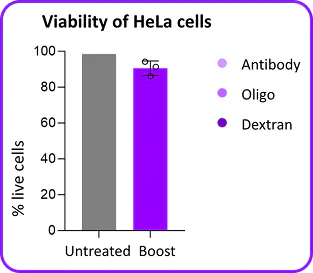
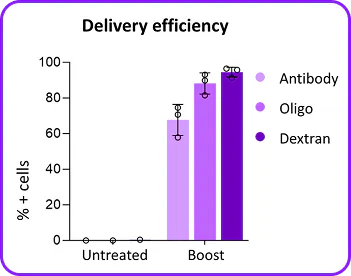
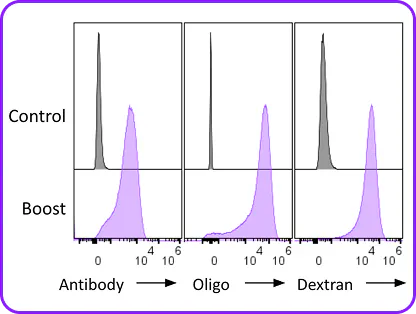
This experiment demonstrates the simultaneous intracellular delivery (“Boost”) of three distinct cargo types—an isotype control antibody, a labeled oligonucleotide, and fluorescent dextran—into HeLa cells. Following delivery, cells were analyzed for viability and uptake efficiency using flow cytometry.

Data Spotlight: Intracellular Antibody-based Detection of Proteins

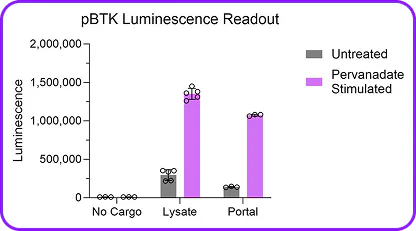
Using Portal’s platform, we simultaneously delivered four Lumit antibodies into live cells to detect phosphorylated BTK (pBTK), a key component of B-cell receptor signaling. The readout matched that of conventional lysate-based assays: cells stimulated with Pervanadate showed strong luminescent signals compared to untreated controls, confirming successful phosphorylation detection.

The experiment compares luminescent signal levels under three conditions: no cargo, lysate, and Portal, for both untreated (gray) and pervanadate-stimulated (purple) samples.

Overall, the data demonstrate that intracellular antibody delivery via mechanoporation successfully detects pBTK in live cells with sensitivity equivalent to conventional lysate-based assays.

1. Szeto GL, Lavin AA, Worku H, Sharei A, Alejandro B, Park C, et al. Ex vivo cytosolic delivery of functional macromolecules to immune cells. PLoS One. 2015;10(4):e0118803. doi: 10.1371/journal.pone.0118803.
2. Sharei A, Trifonova R, Jhunjhunwala S, Hartoularos G, Eyerman A, Cho N, et al. Cell engineering with microfluidic squeezing preserves functionality of primary immune cells in vivo. Proc Natl Acad Sci U S A. 2018;115(10):E2317–E2325. doi: 10.1073/pnas.1714558115.
3. Portal Biotechnologies. SLAS Europe Poster. 2024 Jun. Available from: https://portal-bio.cdn.prismic.io/portal-bio/aFmSDnfc4bHWioTD_SLASEuPoster.pdf
4. Nucleate. Armon Sharei: Origins of SQZ Biotech and the future of cell engineering. Medium. 2023 Jul 10. Available from: https://nucleatehq.medium.com/armon-sharei-origins-of-sqz-biotech-and-the-future-of-cell-engineering-nucleate-insights-3-edb8fa270c15
5. Langreth R. SQZ, Portal founder Armon Sharei on starting over in biotech. BioPharma Dive. 2023 Oct 2. Available from: https://www.biopharmadive.com/