


Predictable, Dose-Dependent Uptake via Passive
Mechanoporation technologies achieve robust intracellular delivery while uniquely preserving cellular homeostasis.




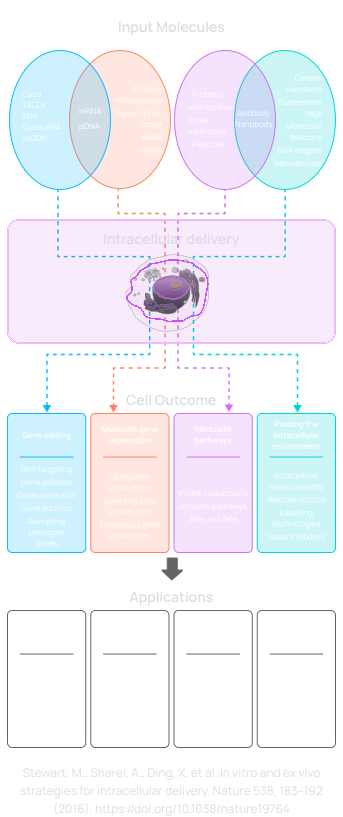


Portal’s technology enables diverse and multiplexed delivery into cells via a simple diffusion mechanism.

Mechanoporation technologies achieve robust intracellular delivery while uniquely preserving cellular homeostasis.
Diffusion Preservation of Cellular Homeostasis and Native State
A single-step workflow enabled robust engineering of multiple modalities to achieve simultaneous CRISPR-mediated gene editing and high-magnitude mRNA expression. This multiplexing proficiency provides a powerful framework for complex biological modeling while completely avoiding cargo-specific biases, staggered expression timelines, metabolic burden, and reduced multi-modal yield associated with sequential transfection protocols.
We leveraged this capability to transiently engineer primary human T cells with circRNA constructs encoding a CD19-targeted chimeric antigen receptor (CAR) and membrane-bound interleukin-12 (mbIL-12). This single-step multi-modal delivery yielded rapid onset and high-magnitude co-expression of both therapeutic modalities, leading to enhanced tumor cell killing efficacy while circumventing permanent genomic manipulation and long-term cellular perturbation.
High-Fidelity Multiplexing Without Loss of Stoichiometry
Upon boosting with GFP self-amplifying RNA (saRNA), human iPSCs were used to generate cerebral organoids. Delivery of saRNA via Portal’s platform results in long-lasting GFP positive cells and does not disrupt lineage commitment or structural scaffolding during a 20-day cerebral organoid maturation protocol.
Transient Engineering for Rapid, Complex Cell Therapy
We validated three distinct implementations, serving as a foundation for a myriad of designs that capitalize on live-cell native MOA study: first, delivering the LgBiT protein directly into cells endogenously tagged with HiBiT facilitated precise, real-time kinetic monitoring of PROTAC-mediated target protein degradation; second, non-viral intracellular loading of an otherwise impermeable Src kinase tracer resulted in dose-dependent competitive displacement by Src small-molecule inhibitors; and lastly, intracellular co-delivery of the four antibody components of the Lumit immunoassay enabled live-cell, wash-free detection of intracellular kinase phosphorylation following pervanadate stimulation with signal-to-background ratios comparable to conventional lysate-based Lumit workflow. By eliminating artificial proxy models and preserving native target conformations, post-translational modifications, and cellular pathways, this direct-to-biology framework compresses validation timelines from months to hours while delivering deeper, physiologically accurate insights into candidate drug mechanisms.
Direct-to-Biology Insights for Early-Phase Drug Discovery
The porous 2D architecture of this platform enables full translational utility across operational scales with simple scaling of design footprint to accommodate throughput requirements, providing a unified framework that bridges the gap between early-stage discovery and large-scale therapeutic manufacturing. For high-throughput (HT) discovery applications, the low-pressure requirements of the silicon membrane enable seamless integration with existing automated cell dispensing instrumentation. This approach leverages a distinct attribute of mechanically-mediated poration: membrane closure can take up to a minute or more, allowing for diffusion of cargo into the cell after the poration event, and enabling a workflow in which cells can be mechanoporated during dispensing into a plate which is pre-loaded with cargo. This principle provides the foundation for automated delivery of cargo in 96- and 384-well formats, achieving uniform cargo delivery across thousands of independent samples without the need for specialized high-pressure infrastructure.
Unified Scalability from Research to Clinical Manufacturing
To evaluate the platform’s compatibility with a multi-step clinical manufacturing process, we performed a longitudinal study involving the sequential engineering of primary human T cells over a 10-day expansion period. The workflow commenced with research-scale delivery of CRISPR RNPs for B2M editing in unstimulated T cells, followed by a standard clinical activation protocol, with robust, >80-fold expansion and high viability up to clinical-scale densities. The population then underwent a second, clinical-scale boost of GFP mRNA using a porous membrane integrated in-line with the LOVO system, resulting in high-efficiency editing and near-universal mRNA expression.
Portal allows you to answers question directly inside your cell, and design it for any function you need. Check out all kinds of benefits!

No vector, no pulse, no carrier
A physical squeeze does the work, so delivery does not depend on the chemistry of the cargo.

Gentle on the cell
Cells keep their phenotype and function, with no electrical or lipid damage.

Works across cells and cargo
Proteins, RNPs, mRNA, peptides, degraders, and impermeable compounds, across primary cells and lines.

Bench to GMP
The same method from a benchtop run to more than a billion cells a minute.
No vector, no pulse, no carrier
A physical squeeze does the work, so delivery does not depend on the chemistry of the cargo.
Gentle on the cell
Cells keep their phenotype and function, with no electrical or lipid damage.
Works across cells and cargo
Proteins, RNPs, mRNA, peptides, degraders, and impermeable compounds, across primary cells and lines.
Bench to GMP
The same method from a benchtop run to more than a billion cells a minute.
Groups at pharma and academic labs put Portal's platform to work on their own cells and cargo. Each talk below walks through what the team ran and what they found.
WEBINAR
Merck's discovery group reads degrader permeability and target engagement by boosting the reporter straight into their own cells, rather than building and maintaining a stable line for every target. Delivering a VHL-NanoLuc reporter into AsPC-1 cells lets the team measure degrader activity and kinetics in the relevant cell background, and a p53/MDM2 peptide assay in HCT116 on an automation-integrated Galaxy returns high viability and delivery.
Watch the WebinarWEBINAR
AbbVie's Small Molecule Therapeutics and Platform Technologies group shows how permeability can hide real compounds, turning active ones into false negatives in a standard assay. Boosting impermeable compounds directly into the cytosol recovers activity that passive uptake misses, including a BRD4 degrader that moves from 82% to 50% protein remaining, while permeable controls behave the same with or without a boost.
Watch the Webinar







Research Scale
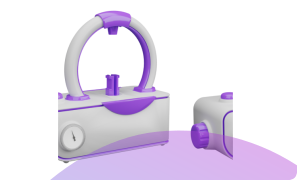
High-Throughput Screening

Clinical Manufacturing
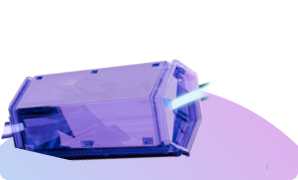
Validated Workflows

Portal enables lots of new, non-obvious applications. Tell us about your work, and we'll give you some suggestions! (Remember AI tools say dumb things sometimes, talking to our team of humans is always best)