


STEM CELL BIOLOGY
iPSC Generation
- Best suited for: PBMCs & fibroblasts
- Available enhancements: Oct4, Sox2, Klf4, cMyc RNA
- Best suited for: Reprogramming, disease modeling

WORKFLOW KIT · NEUROSCIENCE
Deliver transcription factors, ASOs, and reporters into iPSC-derived neurons and progenitors.
Every kit includes: RNA · Optimized protocols · MicroBooster™ cartridges · Suggested readouts · Reagents

Boost NGN2 mRNA into an iPSC and NGN2 rises about 11,000-fold within 12 hours. Boost an antisense oligonucleotide into neuronal progenitors and it reaches 70%+ of live cells and knocks the target down by about 75%. Transcription factors, ASOs, and reporters all go in the same way, in one step, on one cartridge.
The problem
iPSC-derived neurons and neuronal progenitors lose viability fast under electrical or chemical stress. Electroporation gets cargo in and costs viability doing it. AAV and lentivirus express well but bring packaging size limits and weeks of vector production, and lentivirus integrates. None of it suits an experiment where the factor should be present for a few days and then gone.
With this kit
Gateway™ mechanoporation opens each cell by mechanical deformation for a moment, so mRNA, self-amplifying RNA, or an ASO diffuses straight into the cytosol before the membrane reseals. Nothing is packaged into a viral vector and nothing integrates. One boost of NGN2 mRNA drives early neuronal markers by 12 hours, and the same delivery carries a six-factor dopaminergic cocktail (Wu et al., ISSCR 2022).
The delivery step is a single pass through a MicroBooster™ cartridge. Cells go back into neuronal media straight afterwards, so the differentiation clock starts on the day of the boost.
Portal has the Solution

01
Isolate
iPSCs or neuronal progenitors

02
Mix
Cells + cargo (RNA / ASO)

03
Boost
Gateway™ mechanoporation

04
Differentiate
Neuronal media post-boost

05
Confirm
Neuronal markers/knockdown
Unbiased, validated intracellular hits
11,000×
NGN2 induction in iPSCs 12 hours after a single NGN2 mRNA boost
70%+
ASO-positive live neuronal progenitors, with the target knocked down by about 75%
70%+
Live neuronal progenitors after an ASO boost, against 90%+ untreated
The cargo and protocols below make this kit specific. The core consumables, settings, and support ship with every Portal kit.

Available Cargoes

Reagents & Consumables

Protocol & Settings

Support
Available Cargoes
Reagents & Consumables
Protocol & Settings
Support
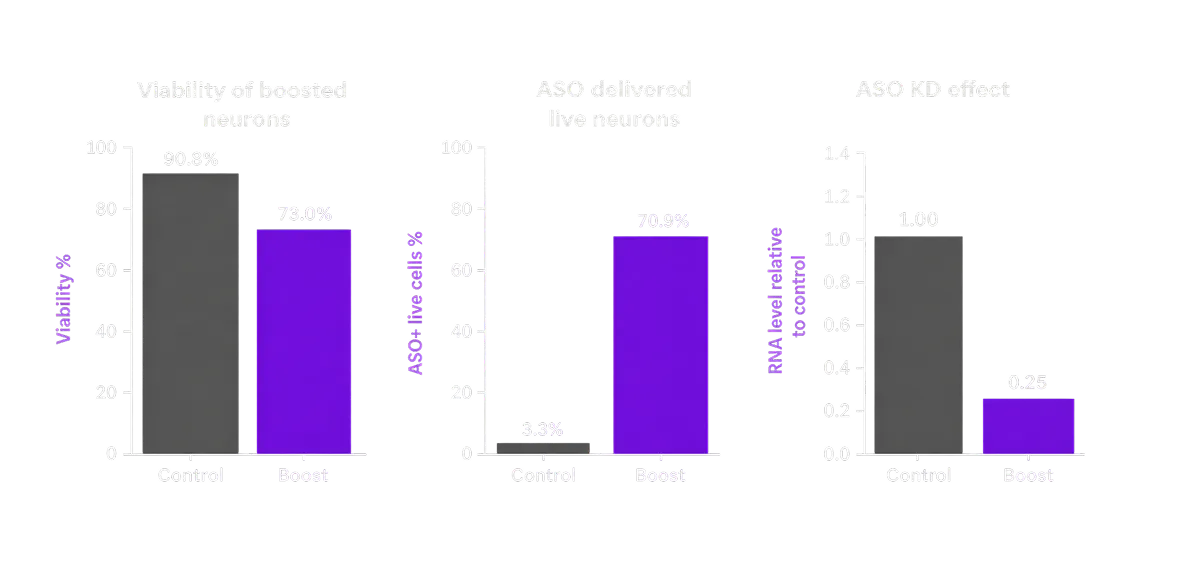
NGN2 neuronal progenitor cells were boosted with an antisense oligonucleotide and read out the same day. About 70.9% of live cells came back ASO-positive against 3.3% for control, and the target transcript dropped by about 75%, to 0.25× of control, so the oligo reached the cytosol in enough copies to act rather than merely to be detected. Viability was 73.0% after the boost against 90.8% untreated, which is what this delivery costs in this cell type.
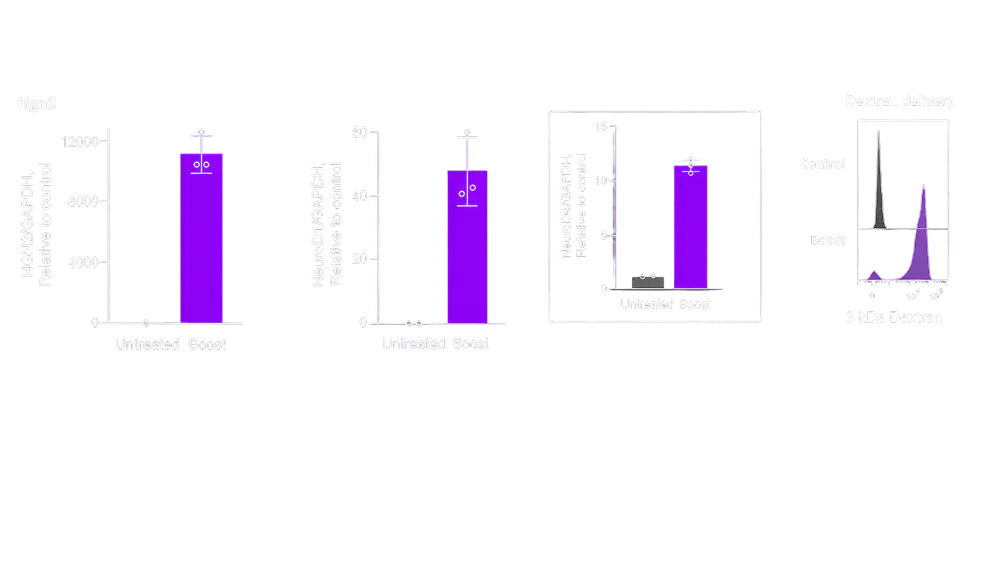
iPSCs boosted with NGN2 mRNA raised NGN2 about 11,000-fold over untreated at 12 hours, with NeuroD1 about 47-fold and NeuroD4 about 11-fold behind it. That downstream pair matters more than the first number: the delivered factor is not just present, it is driving the program it is supposed to drive. A 3 kDa dextran carried in the same boost separates cleanly from control by flow, confirming the cells were opened.

iPSCs were boosted once with Ascl1 self-amplifying RNA together with FoxA2, Lmx1a, Nurr1, Pitx3, and EN1 mRNA, all in the same mix. By day 4 FOXA2 was up about 25,000-fold and tyrosine hydroxylase about 80- to 90-fold over a GFP saRNA control. At day 14 the cells stained for tyrosine hydroxylase alongside TUJ1 and MAP2, the marker set for a dopaminergic neuron. Ascl1 saRNA on its own did not reach those levels, so the six factors are doing the work together. (Wu et al., ISSCR 2022.) The kit supplies ASCL1, LMX1A, FOXA2, and NURR1; PITX3, EN1, and the self-amplifying format are sourced on request.
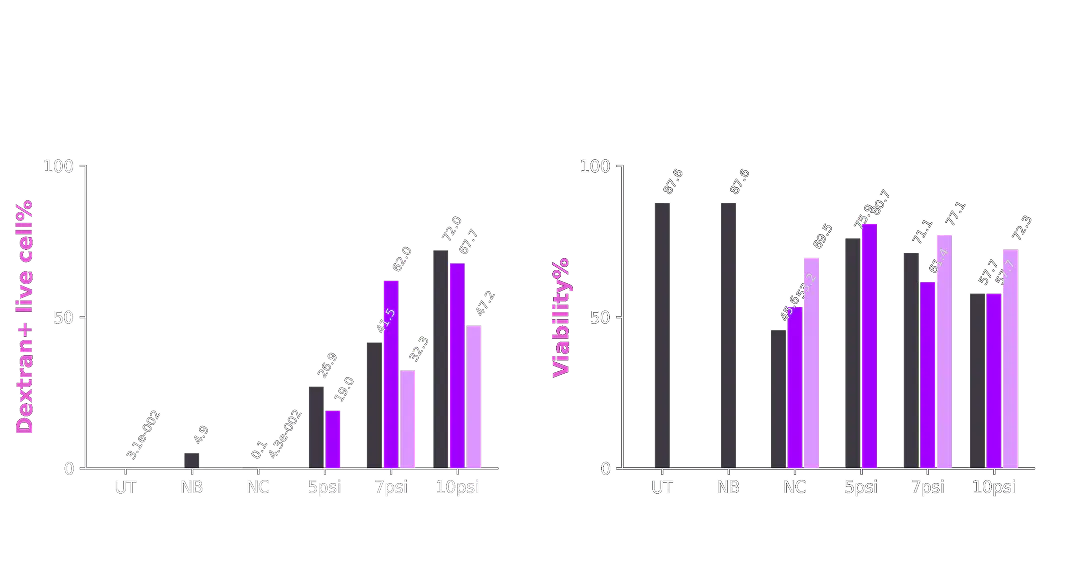
Neuronal progenitor cells were boosted with GFP mRNA and a fluorescent dextran tracer together, across 7.5, 8, and 9 µm chips at 5, 7, and 10 psi. Tracer delivery reached 72.0% of live cells at the strongest condition against 0.03% untreated, and viability held at 80.7% at the mildest against 87.6% untreated. More than 75% of attached progenitors were GFP-positive the next day, from unmodified mRNA with no lipid carrier and no base modification. The matrix exists so the operating point is a choice: stronger conditions for the cargo-positive fraction, milder ones for viability.
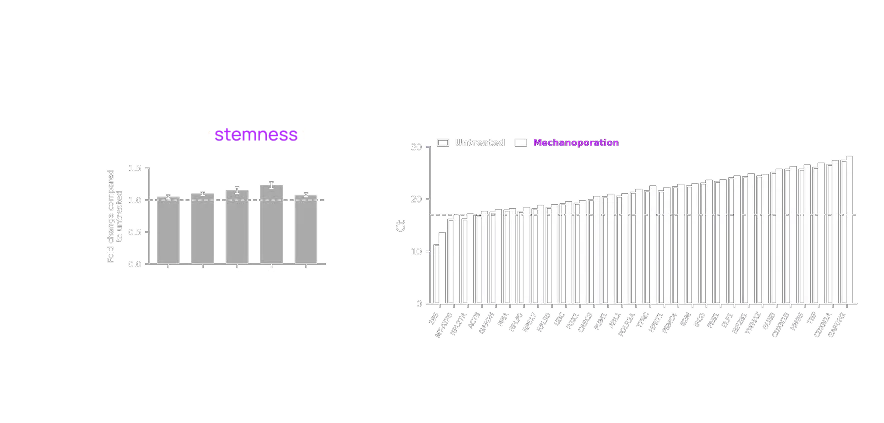
Oct4, Nanog, Sox2, Myc, and TERT all sat within about 1.2-fold of untreated at 24 hours after the boost, and Ct values across 32 housekeeping genes overlapped the untreated set gene for gene. Oct4, Sox2, and SSEA4 protein were unchanged by flow at the same timepoint. A starting population that has not been shifted is what makes the differentiation readout mean anything: markers that come up afterwards came from the delivered factor and not from the handling. (Wu et al., ISSCR 2021.)
Portal — enabling live-cell assays, target engagement, and compound profiling.
Kits include: Optimized protocols · Portal reagents · Delivery cartridges · Suggested readouts
 mRNA, siRNA, saRNA
 Proteins & Peptides
 CRISPR RNPs
 Small Molecules
 Polymers
 Nanoparticles
 Antibodies
 Virus
Virus PBMCs
PBMCs T cells
 B cells
 NK cells
 iPSCs
iPSCs Monocytes
 RBCs
RBCs HSCsmRNA, siRNA, saRNAProteins & PeptidesCRISPR RNPsSmall MoleculesPolymersNanoparticlesAntibodiesVirusPBMCsT cellsB cellsNK cellsiPSCsMonocytesRBCsHSCs