



Controllable Surface Receptor Expression
- Solves: Fixed, hard-to-modulate surface antigen expression in cell lines
- Cargo: Custom antigen/receptor RNA — single or combinations
- Express any antigen on any cell in hours
- e.g. CD19+CD3, BCMA+CD3, HER2+CD3

WORKFLOW KIT · TARGET ENGAGEMENT
Measure intracellular target engagement in live cells, no digitonin, no lysis.
Every kit includes: Delivery tracer · Optimized protocols · MicroBooster™ cartridges · Suggested readouts · Reagents

Run the NanoBRET target engagement assay you already use, on cells that are alive and intact. One pass through a MicroBooster™ cartridge puts an impermeable tracer and the compound into the cytosol together, so you read binding where the target actually sits.
Current Workflow Requires Permeable Tracers
Measuring target engagement traditionally requires making permeable tracers - which can take extra time and monetary investment.

01
Make permeable tracer

02
Make tracer permeable for cell-based target engagement

03
Run target engagement assay
Time Consuming
Portal has the Solution

01
Prepare
NanoLuc-tagged POI cells

02
Mix
Cells + tracer and compound

03
Boost
Gateway™ mechanoporation

04
Incubate
Allow signal to develop

05
Measure
Live-cell NanoBRET signal
Target engagement measured in live cells for any tracer
~20×
Live-cell BRET from a boosted impermeable Src tracer, against the same tracer unboosted
2.3×
Ubiquitination response for partially permeable degraders once delivered, in intact cells
80+%
Delivery held across ten consecutive 96-well plates of HeLa cells
The cargo and protocols below make this kit specific. The core consumables, settings, and support ship with every Portal kit.

Available Cargoes

Reagents & Consumables

Protocol & Settings

Support
Available Cargoes
Reagents & Consumables
Protocol & Settings
Support

We boosted a membrane-impermeable Src kinase tracer into HeLa cells expressing NanoLuc-Src, then challenged it with ponatinib or bosutinib. Boosted cells gave about 20× the BRET signal of unboosted cells. Ponatinib displaced the tracer dose-dependently, cutting the signal about 35% at 1.1 µM, about 55% at 3.3 µM, and about 80% at 10 µM; bosutinib reached about 85% at 10 µM. Unboosted cells stayed at baseline across the whole curve.

Cellular ubiquitination of the target protein in a degrader mechanism-of-action panel run by a pharma partner, showing normalized POI:ubiquitin BRET response. Both partially permeable compounds increased ubiquitination about 2.3-fold after delivery, while DMSO showed no significant difference and the permeable control was unchanged. Ternary complex formation and proteasome recruitment increased to the same extent in the same panel.

Anti-phospho-BTK detection antibodies boosted into human PBMCs and read on a luminescent immunoassay. After pervanadate stimulation, the delivered-antibody arm reached about 80% of the lysate signal, with no-cargo controls near zero: pBTK signal mirrors lysate without permeabilization. Assay chemistry: Promega Lumit.
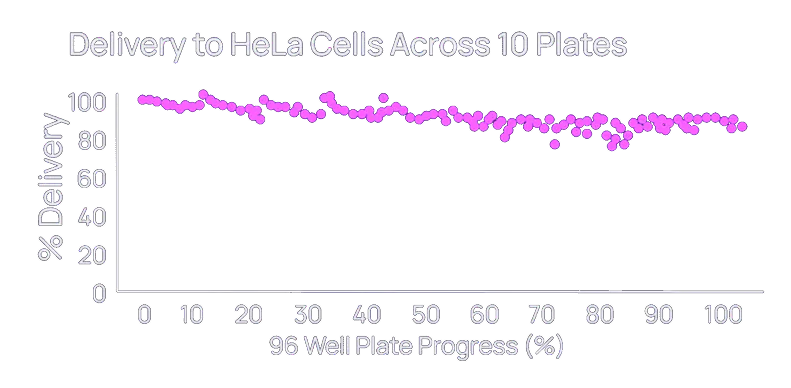
Percent delivery for every well across ten consecutive 96-well plates of HeLa cells, boosted in line with the Powered-by-Portal Galaxy-i consumable on a Certus Flex dispenser. Delivery started near 100% and settled in the high 80s, holding between about 80% and 100% for the whole run. How much tracer gets in sets the BRET ratio, so this consistency keeps dose-response curves comparable from plate to plate. The approach scales directly to high-throughput screening on the Galaxy-i.
 mRNA, siRNA, saRNA
 Proteins & Peptides
 CRISPR RNPs
 Small Molecules
 Polymers
 Nanoparticles
 Antibodies
 Virus
Virus PBMCs
PBMCs T cells
 B cells
 NK cells
 iPSCs
iPSCs Monocytes
 RBCs
RBCs HSCsmRNA, siRNA, saRNAProteins & PeptidesCRISPR RNPsSmall MoleculesPolymersNanoparticlesAntibodiesVirusPBMCsT cellsB cellsNK cellsiPSCsMonocytesRBCsHSCs
Validated live-cell workflows for target engagement, compound profiling, and beyond.
Every kit includes: Cargoes · Optimized protocols · MicroBooster™ cartridges · Suggested readouts · Reagents