

Mechanoporation puts hard-to-deliver cargo into the cytosol

Portal builds the mechanoporation instruments that put proteins, RNPs, mRNA, and impermeable small molecules straight into the cytosol, with the cell intact. Used by 100+ partners, including 10 of the top pharma.

What is mechanoporation?

Mechanoporation is a physical way to get molecules into cells. Cells flow through a constriction slightly smaller than they are, which opens the membrane for a moment. Whatever is in the buffer diffuses straight into the cytosol, and the cell seals back up.
No virus, no electrical pulse, no lipid carrier, and nothing about the cargo has to be re-engineered to get in.

PEER-REVIEWED FOUNDATION

Mechanoporation traces back to a peer-reviewed PNAS paper from MIT.

Sharei, Zoldan, Adamo, et al. "A vector-free microfluidic platform for intracellular delivery." Proceedings of the National Academy of Sciences, 2013.

What mechanoporation does differently

No vector, no pulse, no carrier

A physical squeeze does the work, so delivery does not depend on the chemistry of the cargo.

Gentle on the cell

Cells keep their phenotype and function, with no electrical or lipid damage.

Works across cells and cargo

Proteins, RNPs, mRNA, peptides, degraders, and impermeable compounds, across primary cells and lines.

Bench to GMP

The same method from a benchtop run to more than a billion cells a minute.

No vector, no pulse, no carrier

A physical squeeze does the work, so delivery does not depend on the chemistry of the cargo.

Gentle on the cell

Cells keep their phenotype and function, with no electrical or lipid damage.

Works across cells and cargo

Proteins, RNPs, mRNA, peptides, degraders, and impermeable compounds, across primary cells and lines.

Bench to GMP

The same method from a benchtop run to more than a billion cells a minute.

Key capabilities of mechanoporation

Multiplex delivery: three cargos into the same T cells in one boost

A single boost co-delivers a CRISPR RNP, an mRNA, and a dextran into the same resting T cells, and most cells receive all three at once. Doing it in one operation, rather than sequential rounds of electroporation or transfection, avoids the compounding stress and cell loss of handling the same cells three times.

For a CAR-T or multiplexed-edit workflow, the edit, the transgene, and a trackable label can land together in a single gentle step.

Mechanoporation keeps gene expression near baseline

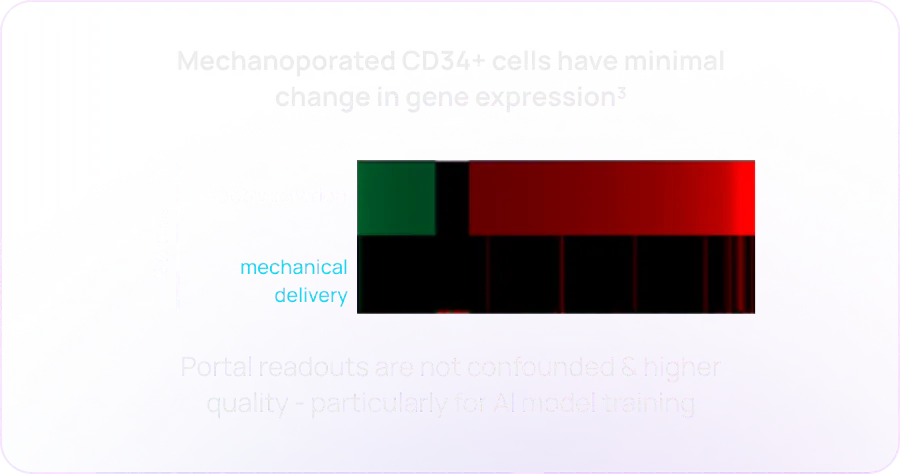
Mechanoporated cells barely shift their transcriptome, while electroporation misregulates gene expression broadly within hours of treatment. Because the cells you assay behave normally, the readout reflects the perturbation you introduced rather than the stress of the delivery itself.

Across a full high-throughput run, viability stays high dispense after dispense, so the population you screen is the one you started with.

iPSCs keep their pluripotency after a boost

iPSCs take up delivered mRNA while staying viable and holding their pluripotency markers, and they still differentiate normally afterward, here into dopaminergic neurons. Stem and progenitor cells are the ones most easily pushed off their fate by harsh delivery, so preserving identity matters as much as delivery efficiency.

A boost engineers these cells without trading away their differentiation potential.

Every PBMC subset in one boost, without pre-isolation

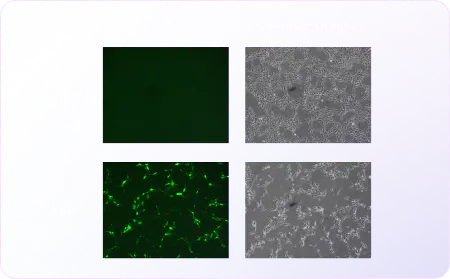
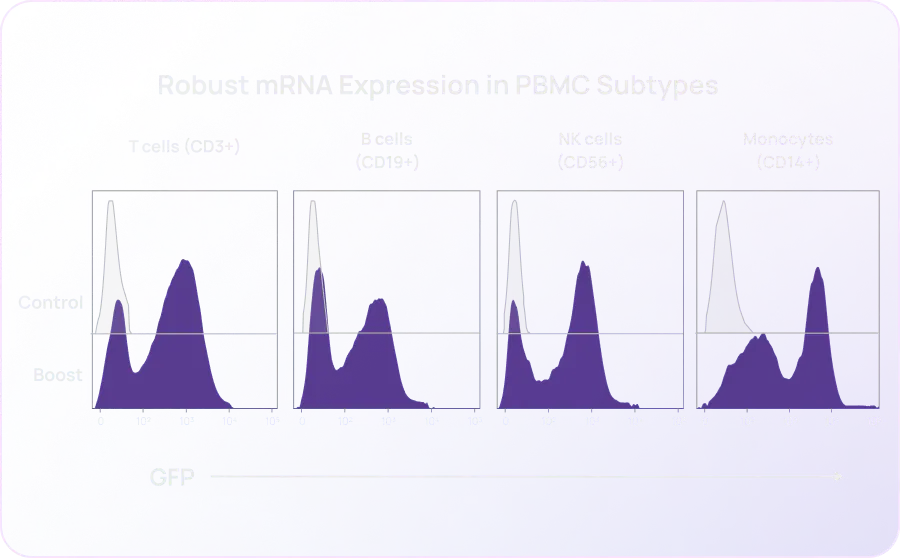
One boost delivers GFP mRNA into every subset of an unseparated PBMC sample, T cells, B cells, NK cells, and monocytes alike. You can engineer straight from a patient sample or a thawed PBMC vial without a sorting or isolation step that costs cells, time, and yield.

That makes it practical to work with the mixed populations that primary-cell biology actually comes in.

Impermeable compounds reach the cytosol and show dose-dependent activity

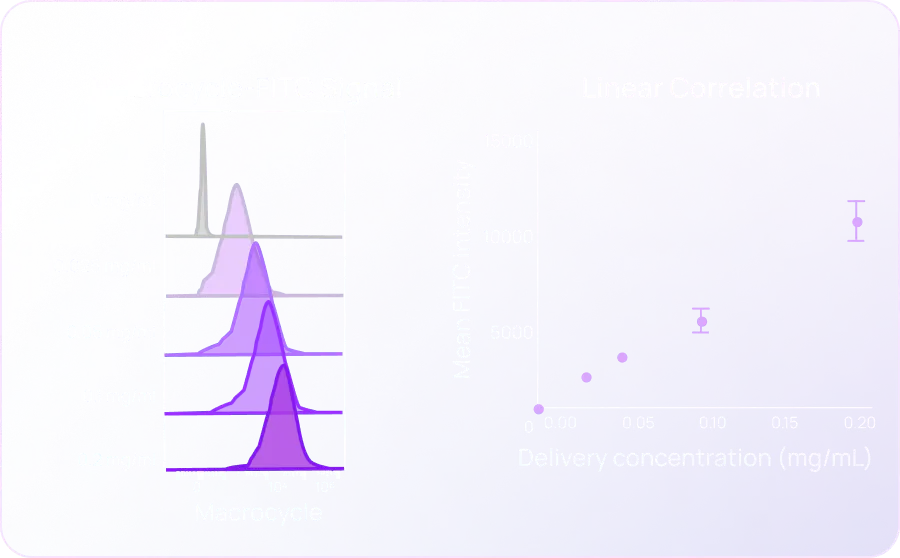
Membrane-impermeable peptides and small molecules that can't cross on their own reach the cytosol by mechanoporation, and delivery scales cleanly with the dose you load. Cells stay viable across the concentration range, so you can build a real dose-response instead of a single endpoint.

Chemical matter that reads as inactive only because it can't get in can finally be tested against its target inside the cell.

How it compares to other delivery methods

Method

Best at

Limitations

Electroporation / nucleofection

Nucleic acids, RNPs

Stresses the cell; often needs pre-activation

Lipofection / LNP

Nucleic acids

No proteins or small molecules; weak in primary cells

Viral (AAV, lentiviral)

Long-term expression

Slow, costly, cargo-size limits, insertional risk

Mechanoporation

Proteins, RNPs, mRNA, impermeable compounds

Plasmid DNA reaches the cytosol, not the nucleus

Mechanoporation for drug discovery

Mechanoporation boosts otherwise cell-impermeable degraders, kinase tracers, and library probes straight into the cytosol, so assays that depend on getting a compound inside the cell can be read without relying on passive uptake. The panels below show dose-response degradation, intracellular target engagement, live-cell degradation kinetics, and DNA-encoded library screening, each measured after a boost.

PROTAC dose-response read by intracellular luminescence

Mechanoporation boosts a cell-impermeable PROTAC straight into the cytosol, so a dose-response can be built from the intracellular concentration rather than from passive uptake. The PROTAC LC-2 was titrated in cells carrying a luminescent degradation reporter, and target signal falls step-wise as the dose increases.

Because the delivered amount scales with how much cargo is loaded, each point on the curve reflects a controlled intracellular dose.

Intracellular target engagement measured by NanoBRET

NanoLuc-Src HeLa cells were dosed with the Src inhibitors ponatinib or bosutinib, and an impermeable NanoBRET kinase tracer was boosted into the cytosol. The BRET ratio decreases as inhibitor concentration rises across a 0 to 10 uM range, reporting displacement of the tracer and loss of intracellular kinase engagement.

Boosting the tracer in produces the on-target signal that no-boost controls do not, so engagement can be quantified in live cells.

Live-cell degradation kinetics with a luminescent reporter

Cells carrying a luminescent degradation reporter were read continuously after degrader treatment, with the compound either boosted in or left to enter passively. The boosted trace drops to about 30% of the DMSO signal within roughly 12 hours, while the non-boosted trace plateaus near 70%, so mechanoporation gives faster and deeper degradation.
A live-cell titration of VH298 in the same reporter format returns a clean concentration-response, confirming the readout tracks intracellular ligand dose.

DNA-encoded library screening inside live cells

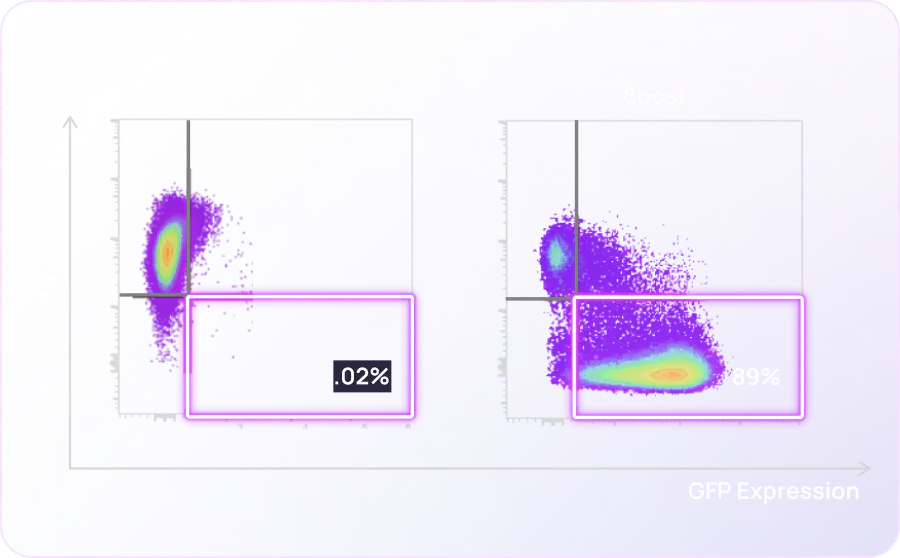
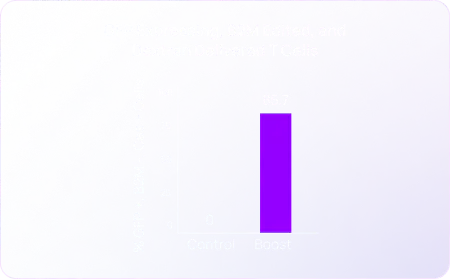
A DNA-encoded library probe, which does not cross the membrane on its own, was boosted into HeLa cells and measured by flow cytometry. About 89% of live cells become probe-positive after the boost versus essentially none in the no-boost control, and the histogram shows the whole population shifting to higher DEL-probe signal.
This puts the library inside intact cells, so binding can be screened against intracellular targets rather than isolated protein.

Broad Compatibility

Portal’s platform supports delivery to a diverse range of cell types and cargoes

Delivery materials
Validated cell types
mRNA, siRNA, saRNA
Proteins & Peptides
CRISPR RNPs
Small Molecules
Polymers
Nanoparticles
Antibodies
Virus
PBMCs
T cells
B cells
NK cells
iPSCs
Monocytes
RBCs
HSCs
Delivery materials
mRNA, siRNA, saRNA
Proteins & Peptides
CRISPR RNPs
Small Molecules
Polymers
Nanoparticles
Antibodies
Virus
Validated cell types
PBMCs
T cells
B cells
NK cells
iPSCs
Monocytes
RBCs
HSCs

Proven in partner labs

Groups at pharma and academic labs put mechanoporation to work on their own cells and cargo. Each talk below walks through what the team ran and what they found.

WEBINAR

Merck: Degrader permeability without a stable cell line

Merck's discovery group reads degrader permeability and target engagement by boosting the reporter straight into their own cells, rather than building and maintaining a stable line for every target. Delivering a VHL-NanoLuc reporter into AsPC-1 cells lets the team measure degrader activity and kinetics in the relevant cell background, and a p53/MDM2 peptide assay in HCT116 on an automation-integrated Galaxy returns high viability and delivery.

View talk

WEBINAR

ABBVIE Rescuing compounds that read as inactive

AbbVie's Small Molecule Therapeutics and Platform Technologies group shows how permeability can hide real compounds, turning active ones into false negatives in a standard assay. Boosting impermeable compounds directly into the cytosol recovers activity that passive uptake misses, including a BRD4 degrader that moves from 82% to 50% protein remaining, while permeable controls behave the same with or without a boost.

View talk

One method, three scales

Gateway

Research Scale

Benchtop instrument for discovery research

  • 0.5-10M cells per run
  • 50-200 µl volume range
  • Compact benchtop unit that fits in any hood
  • Available now

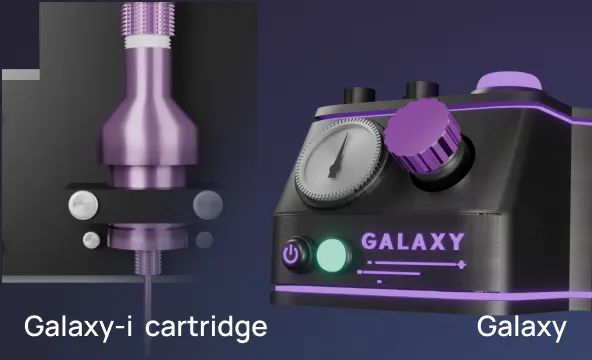
Galaxy-i

High-Throughput Screening

High throughput scale instrument for screening applications with multi well plates.

  • 96/384-well plate compatibility
  • Integrate with existing automation
  • Ideal for DEL, PROTAC, CRISPR screening
  • Available now

Millibooster

Clinical Manufacturing

GMP-ready clinical production system

  • 1 billion+ cells/minute throughput
  • Attach to existing equipment via tube-weld or luer lock connection
  • 2-100mL volume range
  • Available Now

Try it on your own cells

Tell us your cargo and cell type, and we'll connect you with a Portal scientist who brings mechanoporation to your lab. Most teams see first results within a few weeks.

Questions before your first run