


Who this is for
- Lorem Ipsum
Opportunities
- Lorem Ipsum
- Lorem Ipsum
Results obtained
- Lorem Ipsum
- Lorem Ipsum

Macrocycles

Workflow | Example Cell Type | Cargo | Readout | What this Unlocks |
Lorem | Lorem | Lorem | Lorem | |
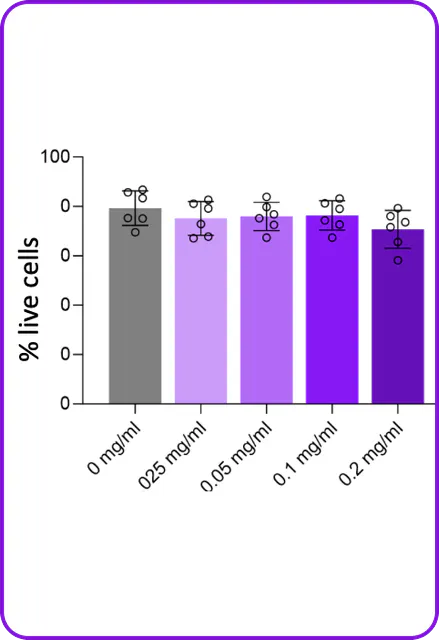
Portal's technology enables macrocycle delivery without compromising cell health. When evaluated across a range of escalating macrocycle concentrations, HeLa cell viability remained stable throughout. At the untreated baseline control (0 mg/mL), cell viability was approximately 80%. As the macrocycle dose escalated through 0.025 mg/mL and 0.1 mg/mL, viability remained nearly identical to baseline, and no significant drop-off was observed even at the maximum concentration of 0.2 mg/mL. This consistent viability across the full 0–0.2 mg/mL dosing range highlights the exceptionally low cytotoxicity of Portal's delivery method.

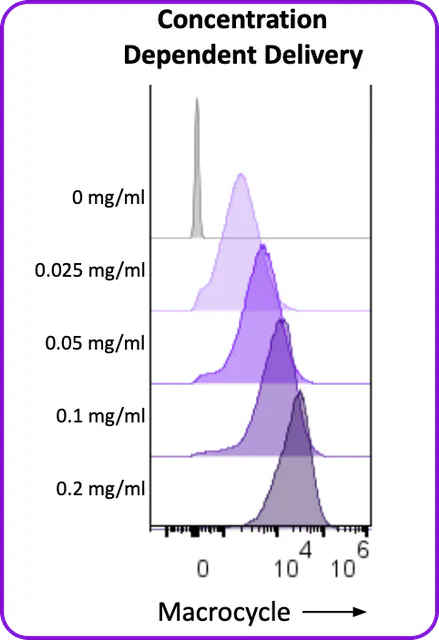
Intracellular delivery of macrocycles into HeLa cells was achieved with efficiency. Following delivery, the percentage of FITC-positive live cells showed a strong, clear, dose dependent increase. Untreated cells (0 mg/ml) exhibited 0% delivery, treated cells achieved approximately 50% delivery efficiency at lowest active dose of 0.025 mg/ml. This efficiency scaled up ~80% at 0.05 mg/ml, and achieved near-total intracellular delivery–approximtely 90% to 100% efficiency–at the peak macrocycle concentrations of 0.1 mg/ml and 0.2 mg/ml. These results demonstrate the platform’s ability to drive cargo uptake at scale while preserving overall cell integrity.

HEK293 cells are treated with FITC-labeled macrocycles utilizing Portal’s delivery technology (Boosting). Fluorescence microscopy provides visual evidence of successful macrocycle delivery into HEK293 cells. While untreated baseline groups show no fluorescence, the Boost-treated cells exhibit robust intracellular accumulation of FITC-labeled macrocycles.
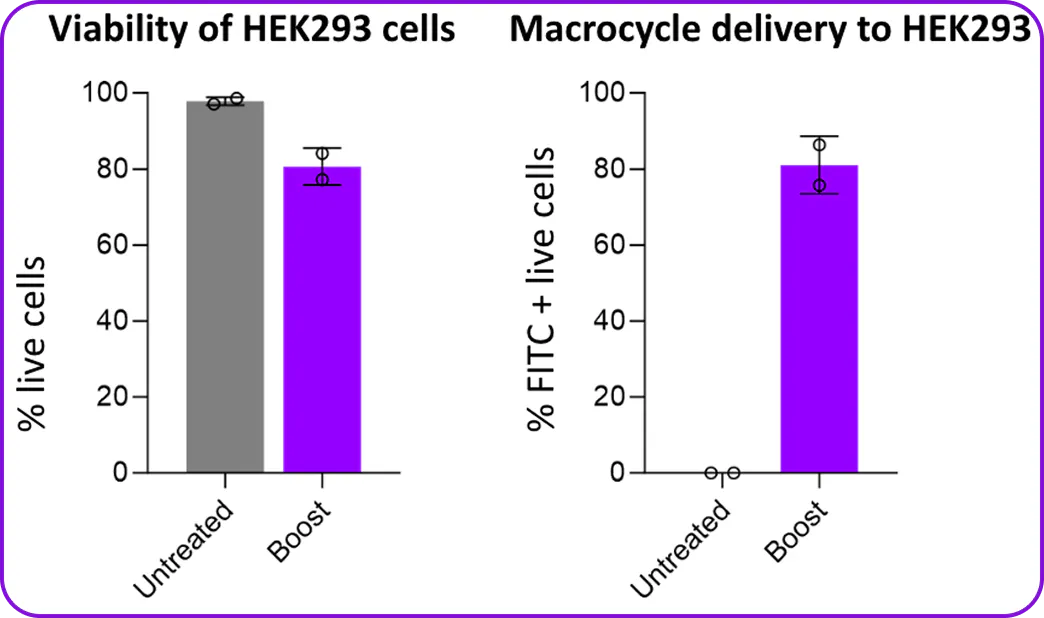
Flow cytometry demonstrates that the Portal delivery platform achieves massive efficiency while protecting overall HEK293 cell health. Quantitative analysis reveals that approximately 80% of treated cells successfully took up macrocycles(measured as FITC-positive live cells), compared to the 0% delivery seen in the untreated baseline. Crucially, this high-volume intracellular delivery was accomplished while maintaining a strong overall cell viability of roughly 80% (compared to the ~100% viability of the untreated control). These metrics demonstrate the platform's ability to balance highly efficient cargo delivery with the preservation of a robust, living cell population.
Boost any cargo into any cell, and unlock novel assays and next-gen cell therapies.

 mRNA, siRNA, saRNA
 Proteins & Peptides
 CRISPR RNPs
 Small Molecules
 Polymers
 Nanoparticles
 Antibodies
 Virus
Virus PBMCs
PBMCs T cells
 B cells
 NK cells
 iPSCs
iPSCs Monocytes
 RBCs
RBCs HSCsmRNA, siRNA, saRNAProteins & PeptidesCRISPR RNPsSmall MoleculesPolymersNanoparticlesAntibodiesVirusPBMCsT cellsB cellsNK cellsiPSCsMonocytesRBCsHSCs